Tarek Mansour built the first federally regulated exchange in America where people can legally trade on the outcome of real-world events. By December 2025 the company had made him a billionaire before he turned thirty. His story runs from a Lebanese classroom to MIT to a landmark ruling that legalized election markets in the United States.
This profile covers where Mansour came from, how he built Kalshi, the regulatory war that defined the company, and where both he and the prediction-market industry stand in 2026. Smart Bet Insider tracks the prediction markets reshaping how people wager on real-world outcomes, and few figures have shaped that shift more than Mansour.
From Lebanon to MIT
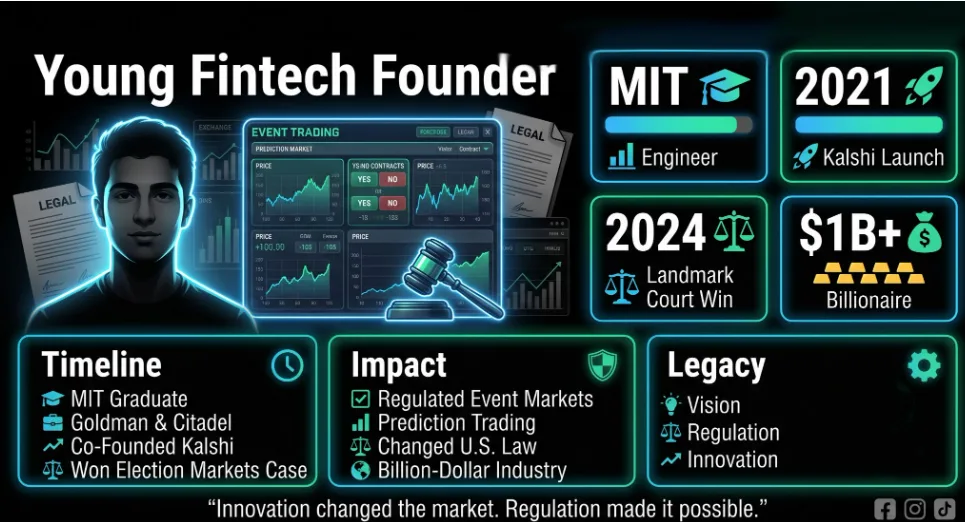
Mansour was born in California and grew up in Lebanon, where he attended Collège Louise Wegmann. He returned to the United States in 2014 to study at the Massachusetts Institute of Technology. He graduated in 2018 with bachelor’s degrees in mathematics and computer science, plus a master’s of engineering.
His résumé before Kalshi reads like a finance pipeline. He interned at Goldman Sachs in 2016 as a structured credit and equities analyst, then traded global macro at Citadel. Those two seats gave him a front-row view of how big money actually bets on the future.
The pattern he noticed there became the company. A large share of institutional trading came down to an opinion about a future event, yet no clean market existed to express it directly. Banks instead sold clients complicated bundles that only approximated the real bet.
The Idea Behind Kalshi
Mansour’s Goldman work crystallized the gap. Institutions wanting exposure to an event like Brexit had to buy intricate packages of swaps and options, expensive proxies for what was really a simple yes-or-no question. The event itself had no direct market.
In 2018 he co-founded Kalshi with MIT classmate Luana Lopes Lara to build exactly that: a regulated exchange for “event contracts.” The pair took the company through the Y Combinator accelerator to secure early funding and sharpen the model.
The design choices reflected Mansour’s background. Kalshi was built regulation-first, with KYC checks and segregated customer funds, and it used a traditional central limit order book rather than the automated market makers offshore platforms relied on. Compliance came before speed.
The Regulatory War
The hard part was not the technology. It was convincing the government that event contracts were not gambling. Mansour spent nearly two years working with the Commodity Futures Trading Commission, which granted Kalshi designated contract market status in 2020. The exchange launched in 2021.
The fight escalated over elections. In June 2023 Kalshi self-certified contracts on which party would control Congress, and that September the CFTC blocked them in a 3-2 vote, calling them gaming and a threat to election integrity. Kalshi sued in November 2023.
The company won. In September 2024 a federal judge ruled that the CFTC had overstepped, reasoning that elections are not “games” and so election contracts fell outside the agency’s gaming authority. Mansour called it a watershed, saying election markets were legal in the US for the first time in 100 years. The CFTC dropped its appeal in May 2025.
The Sports Contract Fight
Victory on elections opened a new front. In January 2025 Kalshi began listing sports event contracts, starting with the Super Bowl and conference championship games. The move drew immediate fire from state regulators who saw it as nationwide sports betting without state licenses.
The legal map fractured quickly. Kalshi won a preliminary injunction against New Jersey in April 2025 and a favorable ruling in California, while a Nevada court denied relief in August 2025 and a Massachusetts judge issued an injunction in January 2026. The core dispute is whether federal commodities oversight preempts state gambling law, a question now climbing the appellate courts.
The pressure widened beyond regulators. A litigation funder backed suits in multiple states using versions of the 18th-century Statute of Anne, and in November 2025 a putative class of users filed the first major consumer action against a prediction market.
Where Mansour Stands in 2026
The legal turbulence has not slowed the company’s rise. Kalshi reached a $2 billion valuation in a Paradigm-led deal in 2025, and later reporting put the figure far higher as the platform scaled. Mansour’s net worth, drawn from his roughly 12% stake, crossed into billions in December 2025 when he was 29.
Kalshi also gained political tailwinds. The CFTC’s posture softened under the Trump administration toward embracing event contracts, and Donald Trump Jr. publicly credited the platform on election night. Mansour, meanwhile, has kept his personal life private while remaining the company’s public face in Congress and before regulators.
His legacy is already written into the market structure. Mansour turned a category that did not legally exist into a multibillion-dollar industry, and whether history reads him as a pioneer or a disruptor, he changed how Americans can price real-world risk. Smart Bet Insider follows the prediction markets he helped build and the regulatory fights still shaping them. Check the analysis to stay ahead of where event contracts go next.
Frequently Asked Questions
Who is Tarek Mansour?
Tarek Mansour is the co-founder and CEO of Kalshi, the first federally regulated event-contract exchange in the United States. Born in California and raised in Lebanon, he graduated from MIT in 2018 and worked at Goldman Sachs and Citadel before launching Kalshi that year. He became a billionaire in December 2025 at age 29.
What is Kalshi and what does it do?
Kalshi is a CFTC-regulated exchange where users trade event contracts, yes-or-no wagers on real-world outcomes like elections, economics, weather, and sports. It received designated contract market status from the CFTC in 2020 and launched in 2021. Unlike offshore prediction markets, it operates under federal oversight with KYC verification and segregated customer funds.
How did Tarek Mansour come up with the idea for Kalshi?
While trading at Goldman Sachs and Citadel, Mansour noticed that much institutional trading hinged on opinions about future events, yet no direct market existed to express them. Clients instead bought complex bundles of swaps and options as proxies. He co-founded Kalshi in 2018 with MIT classmate Luana Lopes Lara to build a clean, regulated market for those event-based bets.
Why did Kalshi sue the CFTC?
The CFTC blocked Kalshi’s congressional control contracts in September 2023, ruling them gaming and a risk to election integrity, and Kalshi sued. A federal court sided with Kalshi in September 2024, finding that elections are not games and fall outside the CFTC’s gaming authority. The CFTC dropped its appeal in May 2025, legalizing regulated election markets.
What is Tarek Mansour’s net worth?
Tarek Mansour became a billionaire in December 2025 at age 29, with his wealth tied to a roughly 12% stake in Kalshi. Estimates vary by date and valuation, ranging from about $1.3 billion to higher figures as the company’s valuation climbed through late 2025 and 2026. The exact number shifts with each funding round and market move.