
Polymarket’s Supreme Court tariffs market became one of the most closely watched event contracts of the year, a real-money gauge of whether the justices would let President Trump’s IEEPA tariffs stand. Traders priced it weeks ahead, swinging the odds with every oral-argument exchange and lower-court signal. The market read the outcome correctly, and the path it took there is a case study in how prediction markets work.
This piece walks through how the market moved, what each price swing tracked, and what the resolved contract reveals about reading legal odds. Smart Bet Insider covers prediction markets and the events that move them, and the tariff case offers one of the clearest windows into how a market prices a Supreme Court decision in real time.
What the Market Actually Asked
The headline contract asked a precise question: would the Supreme Court rule in favor of Trump’s tariffs? A “Yes” share paid out if the Court reversed or vacated the Federal Circuit’s holding that the tariffs exceeded the President’s authority under the International Emergency Economic Powers Act. A “No” share paid if the Court affirmed that the tariffs were unauthorized.
The resolution criteria were strict. The government had to win on the merits, with a remand on remedy or scope still counting as a government win. An affirmance that the tariffs were unauthorized resolved the market against the government, even if the Court tinkered with the remedy.
That precision matters for any prediction market. Traders were not pricing a vibe about Trump or tariffs broadly. They were pricing one binary legal outcome with clearly defined edges, which is exactly the structure that lets a market produce a clean probability.
The Price Timeline
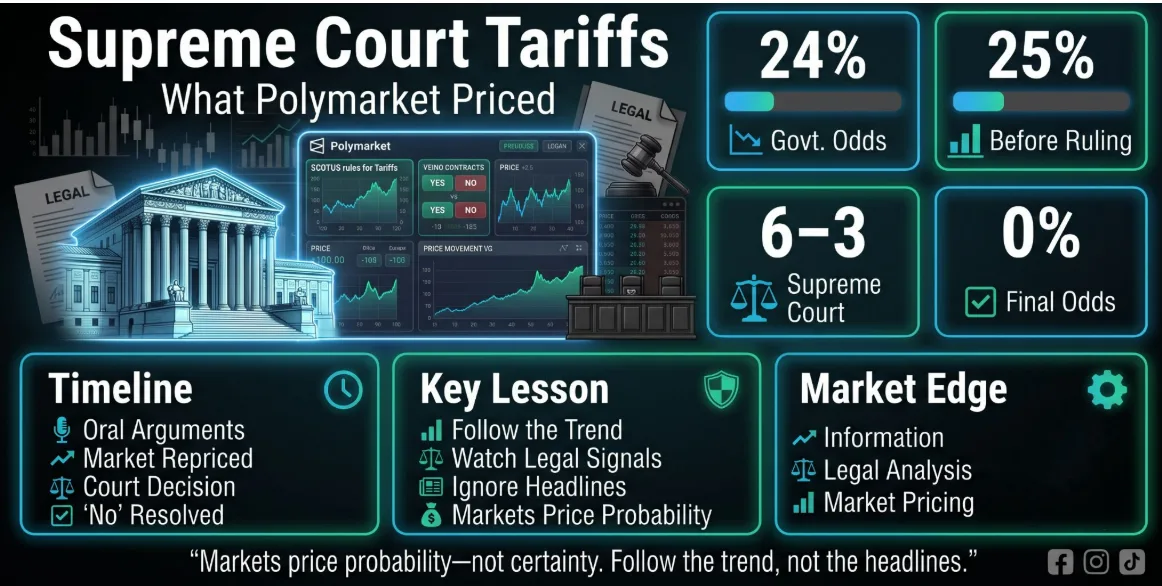
The market told a story in its swings. After oral arguments in November 2025, traders priced the government’s chance of prevailing at roughly 24% on Polymarket. The justices’ skepticism during argument had already leaked into the price.
Then the number jumped. In early January 2026 one reading put the probability of the Court overturning the tariffs near 77%, with the government’s odds correspondingly low, as legal commentary and lower-court signals hardened the consensus. The market briefly wobbled back toward 30% in mid-to-late January amid fresh tariff headlines, showing how external noise can reprice even a legal contract.
By February 17, days before the ruling, Polymarket priced the government’s chance of winning at 25%, down from a 33% peak on February 6. The market had settled near its eventual answer well before the opinion dropped.
What Moved the Odds
The price tracked the courtroom. During the November arguments, the justices questioned whether IEEPA authorized emergency tariffs at all, with Chief Justice Roberts noting that Congress holds the core power over taxation and rejecting the claim that tariffs are not taxes. Skeptical questioning from both conservative and liberal justices pushed the government’s odds down and kept them there.
The non-delegation theme deepened the read. Justices probed whether upholding the tariffs would hand the President a core congressional power through ambiguous statutory language, the exact logic the majority opinion later used. Traders watching the argument transcript were pricing the major-questions doctrine before the Court named it.
External shocks created the noise. A weekend of new tariff threats in January briefly lifted the government’s odds, a reminder that even a tightly defined legal market reprices on political headlines that have nothing to do with the merits.
How the Market Resolved
On February 20, 2026, the Court ruled 6-3 that IEEPA does not authorize the President to impose tariffs. Chief Justice Roberts wrote the opinion, joined by Justices Sotomayor, Kagan, Gorsuch, Barrett, and Jackson, with Thomas and Kavanaugh dissenting. The decision struck down both the “Liberation Day” reciprocal tariffs and the fentanyl-linked duties.
The market resolved against the government, vindicating the traders who had held “No” since oral arguments. As of today the contract shows a 0% chance of the government prevailing, the settled price of a decided case. The related refund market, asking whether importers would recover collected duties, resolved to “Yes” after the Court of International Trade ordered refunds with interest.
The accuracy is the takeaway. From the moment arguments ended, the market signaled a government loss and never seriously wavered from that read, even through January’s headline-driven swings. The crowd priced the ruling months before it arrived.
Why This Matters for Prediction-Market Readers
The tariff case is a clean demonstration of what prediction markets do well. A precisely defined legal question, deep liquidity, and a steady flow of public signals let the market converge on the right answer ahead of the event. The contract drew millions in trading volume, which sharpens the odds by drawing in informed money.
The limits matter too. The January repricing on Greenland-related tariff news shows that even a legal market absorbs irrelevant noise, and a single dramatic swing can mislead a reader who checks the price once rather than tracking the trend. A market is a probability, not a verdict.
For anyone reading prediction markets, the lesson is to watch the trend against the events driving it. The tariff market rewarded traders who priced the oral arguments over those who chased headlines. Smart Bet Insider tracks the prediction markets pricing the next major legal and political events. Check the analysis before you read a single day’s odds as the final word.
Frequently Asked Questions
What was the Polymarket Supreme Court tariffs market?
It was a prediction market contract asking whether the Supreme Court would rule in favor of Trump’s tariffs imposed under the International Emergency Economic Powers Act. A “Yes” share paid out if the Court upheld the tariffs, and a “No” share paid if the Court ruled them unauthorized. The market drew millions in trading volume before resolving.
How did the market price the case before the ruling?
Traders priced the government’s chance of winning at roughly 24% after November 2025 oral arguments, reflecting the justices’ skepticism. The odds swung through January and February 2026 on legal commentary and tariff headlines, sitting near 25% days before the decision. The market consistently favored a government loss from the moment arguments ended.
How did the Supreme Court actually rule?
On February 20, 2026, the Court ruled 6-3 in Learning Resources, Inc. v. Trump that IEEPA does not authorize the President to impose tariffs. The majority opinion, written by Chief Justice Roberts, struck down both the reciprocal “Liberation Day” tariffs and the fentanyl-related duties. The ruling matched what the prediction market had signaled for months.
Did Polymarket traders predict the outcome correctly?
Yes. From the close of oral arguments, the market priced a government loss and never seriously moved off that read, even through January headline swings. The contract resolved against the government, rewarding traders who held “No” shares. The market converged on the correct answer well before the ruling.
Can prediction markets reliably predict Supreme Court decisions?
Prediction markets price probabilities, not certainties, and they perform best on precisely defined questions with deep liquidity and steady public signals, as the tariff case had. The market read the oral arguments accurately, but it also absorbed irrelevant noise, briefly repricing on unrelated tariff headlines. Reading the trend against the underlying events matters more than any single day’s odds.