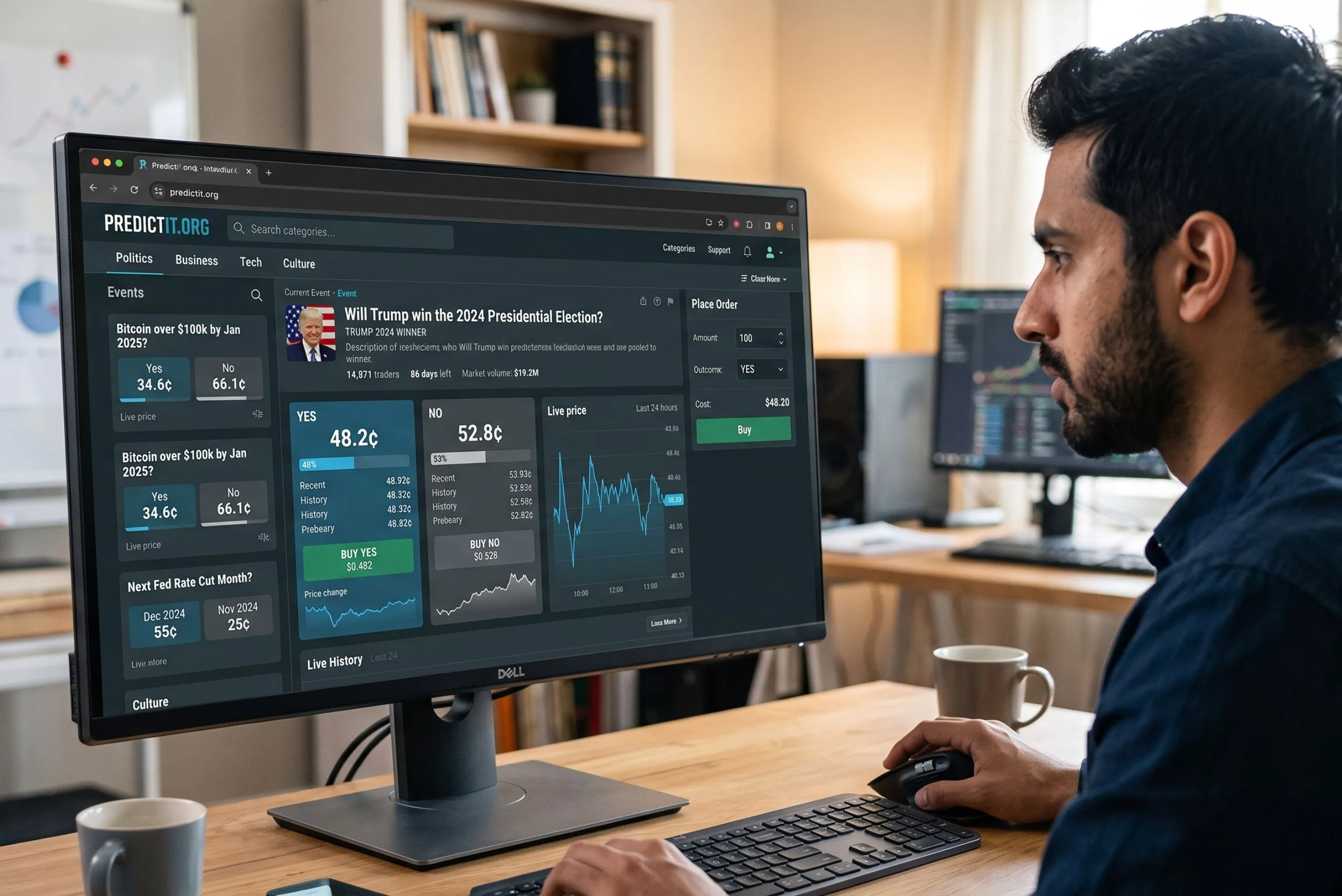
Polymarket odds confuse newcomers because they do not look like sportsbook odds at all. There is no +150 or -200, just a price between 0 and 100 cents. That price simply reflects how the market functions. On Polymarket, the price of a share is the market’s estimate of how likely the outcome is, expressed as a percentage. A contract trading at 64 cents means traders collectively put the odds of it happening at roughly 64%.
Once that clicks, the entire platform reads like a probability dashboard. Every market shows a crowd-sourced estimate, updated in real time as real money moves. Smart Bet Insider covers prediction markets and how to read them, and Polymarket is the largest of them. The sections below break down how the price works, why Yes and No prices relate, and how to read the number without fooling yourself.
The Price Is the Probability
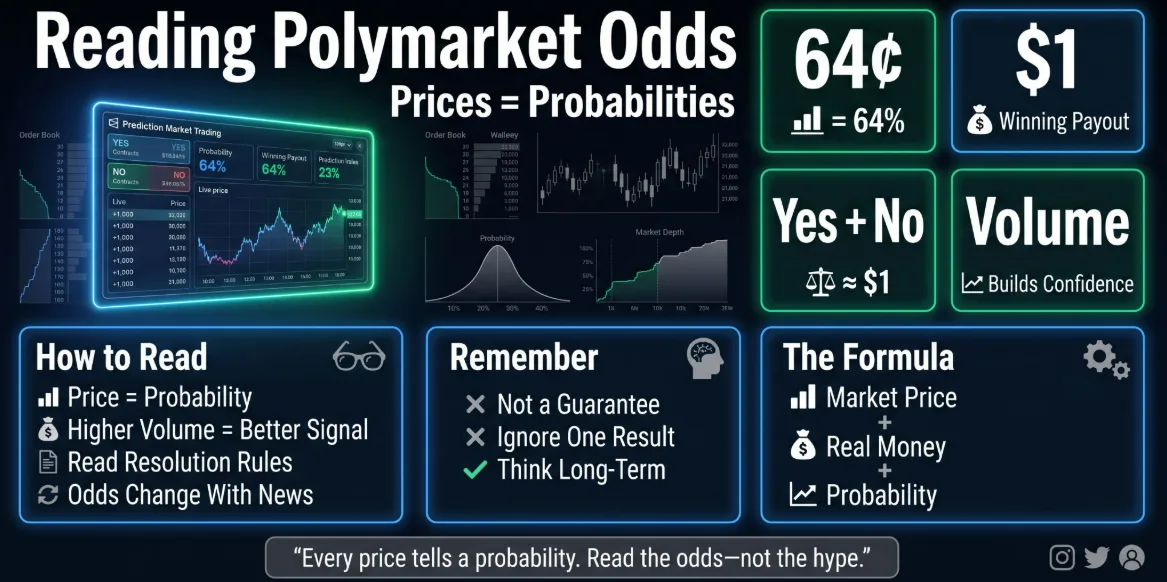
Every Polymarket outcome trades between 0 and 100 cents, and that price equals the implied probability of the event happening. A share at 30 cents reads as a 30% chance. A share at 92 cents reads as a 92% chance. No conversion math, no American-odds decoder ring.
The payout structure is what anchors the price to probability. Each winning share pays exactly $1 when the market resolves, and each losing share pays $0. A share priced at 30 cents pays $1 if the event happens, so the price is what the crowd will pay for that chance.
Yes and No Always Pair to a Dollar
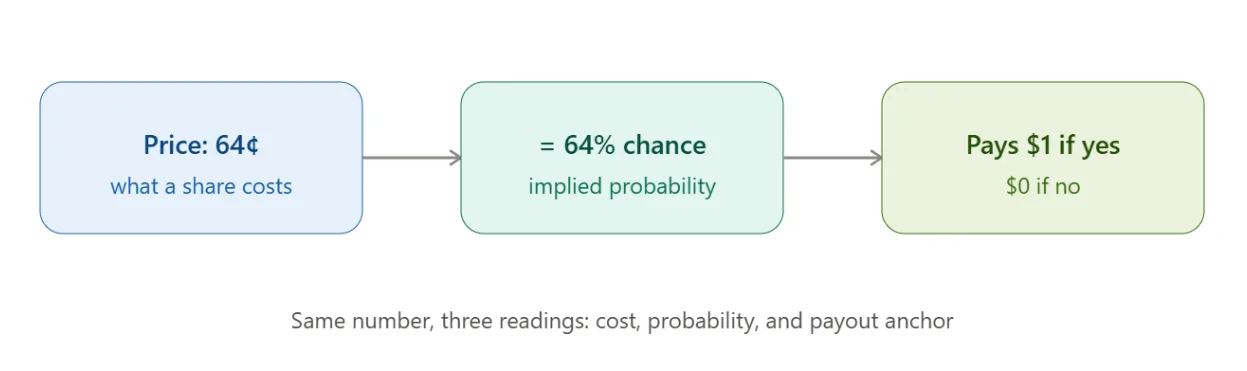
Every market has two sides, and their prices add up to roughly $1. If Yes trades at 64 cents, No trades near 36 cents. The two prices split the full probability between them, which is why reading one side tells you the other.
That pairing comes from how the market is built. Prices emerge from an order book, where a Yes buyer at 64 cents and a No buyer at 36 cents match to mint a complete $1 share. Polymarket does not set the number; supply and demand do.
When the two sides sum to more than $1, the gap is the spread, the cost of trading in and out. A tight market with deep volume keeps that gap small, which makes the price a cleaner read on the true probability.
Reading the Number Without Fooling Yourself
A price is a probability estimate, not a guarantee. A market at 80% means the crowd expects the event four times out of five, which also means it fails one time out of five. A favorite losing is not the market being wrong; it is the one-in-five landing.
Longshots deserve the same care. A contract at 4% will happen sometimes, and a string of 4% events resolving No tells you nothing about the price being off. Judge a market by whether its probabilities are calibrated over many events, not by a single result.
Always read the resolution rules before trusting a number. Each market defines exactly what counts as Yes, what source settles it, and when. A price only means what the resolution criteria say it means, and a vague question makes for a vague probability.
Why the Price Moves, and When to Trust It
A Polymarket price is not fixed. It moves every time a trader reacts to new information, so a market sitting at 40% can jump to 70% the moment a headline breaks. The price is a live reading of what the crowd believes right now, which is why it often shifts before traditional polls or pundits catch up.
Volume decides how much weight the number carries. A market trading at 70% on millions of dollars reflects deep, informed money pushing toward the true probability. The same 70% on a few thousand dollars reflects a handful of traders, and a single large bet can swing it.
That gives you a simple reliability test. The more money behind a price, the closer it sits to an estimate, and the thinner the market, the more a price is just noise wearing a percentage. Check the volume before you trust the odds.
The track record backs the principle in liquid markets. Polymarket reports its odds are accurate more than 90% of the time a full month before a market resolves, and above 98% within four hours of resolution.
Putting It Together
Reading Polymarket comes down to three habits. Treat the cents price as a percentage. Remember that Yes and No split a dollar, so the spread between them is the trading cost. Read the price as a probability that includes the chance of being wrong.
The number is a live crowd estimate backed by real money, which makes it sharper than a poll but never a crystal ball. A 70% market and a 95% market are both uncertain; they just carry different odds. Smart Bet Insider covers prediction markets and how to read what their prices are telling you. Check the analysis before you take any single price at face value.
Frequently Asked Questions
How do Polymarket odds work?
Polymarket prices each outcome between 0 and 100 cents, and that price equals the implied probability of the event happening. A share trading at 64 cents reflects a 64% crowd-estimated chance. Each winning share pays $1 at resolution and each losing share pays $0, which anchors the price to probability.
What does it mean when a Polymarket share is 30 cents?
A 30-cent share means the market estimates a 30% chance the outcome happens. It also means you pay 30 cents for a share that pays $1 if the event occurs, returning 70 cents of profit, or $0 if it does not. The price and the probability are the same number expressed two ways.
Why do Yes and No prices add up to a dollar?
Yes and No prices sum to roughly $1 because together they cover every possible outcome, splitting the full probability between them. A Yes buyer and a No buyer combine to mint one complete $1 share through the order book. When the two sides total more than $1, the extra is the spread, which reflects trading costs.
Does a high Polymarket price guarantee the outcome?
No. A price is a probability, not a certainty, so an 80% market still fails one time in five. A favorite losing does not mean the market was wrong; it means the less likely outcome landed. Prediction markets are judged on calibration across many events, not on any single result.
How does a Polymarket market get resolved?
Each market has published resolution criteria specifying exactly what counts as a winning outcome, the official source used to settle it, and the deadline. When the event concludes or the deadline passes, winning shares pay $1 and losing shares pay $0. Reading these rules before trading matters, because the price only means what the resolution criteria define.