
The Polymarket CLARITY Act market lets you bet on the same crypto law that would reshape crypto regulation. The bill sorts digital assets between two agencies, and its odds of passing trade live on Polymarket, swinging dozens of points in weeks. Traders read legislative tea leaves and price them in real time, which makes the bill worth understanding from both sides of the screen.
Prediction-market traders are really watching two stories at once: what the law does to digital assets, and a separate fight over what platforms like Polymarket can list. Smart Bet Insider tracks the legislation and the odds attached to it. The sections below separate the bill itself from the rules that govern the markets betting on it, and show where the two get confused.
What the CLARITY Act Actually Does
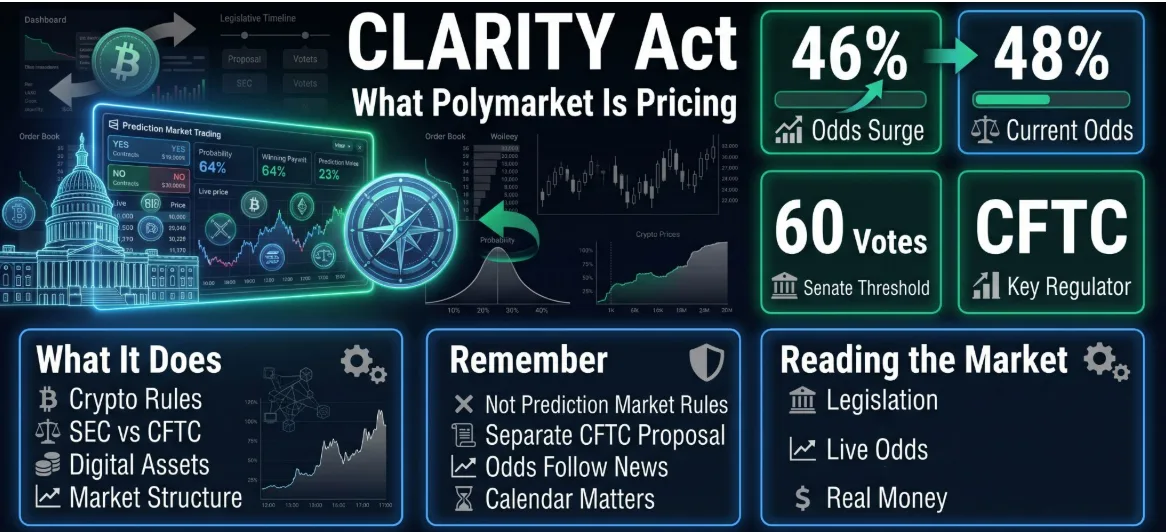
The Digital Asset Market CLARITY Act sorts every digital asset into one of three categories. Digital commodities, tokens whose value comes from a working blockchain like Bitcoin or Ether, go to the CFTC. Investment-contract assets, tokens sold to raise capital with a promise to build, stay with the SEC. Payment stablecoins get joint oversight from both agencies.
The Senate Banking Committee frames the bill as drawing a bright line between SEC and CFTC jurisdiction, replacing a decade of enforcement actions with a written statute. A token can also change category over time, moving from SEC oversight to CFTC oversight as its network decentralizes, without a single line of its code changing.
One provision draws steady fire. The bill prohibits platforms from paying passive yield on idle holdings, while allowing activity-based rewards like cash back. That single restriction has become one of the harder points in the Senate negotiation, and traders watching the bill track it closely.
Why Polymarket Traders Keep Repricing It
The bill’s passage odds have behaved like a volatile asset, because that is effectively what they are. Polymarket priced 2026 passage near 46% in early May, spiked to 73% just before a pivotal Senate Banking markup, then slid back toward 47% to 48% by late June. A 26-point round trip in seven weeks is not noise. Each swing tracks a specific event.
The mid-May jump followed the committee advancing the bill in a 15-9 vote, with two Democrats crossing over. The slide that erased it followed a stall over ethics and illicit-finance provisions, the parts of the bill aimed at money laundering and sanctions evasion. Those fights, not the bill’s popularity, drove the repricing.
The hardest obstacle the odds appear to price is arithmetic. The bill needs 60 votes in the Senate, and the August recess functions as the last realistic gate before the calendar runs out. Galaxy Research moved its own 2026 estimate down to roughly even, citing the same tightening window the market did.
The Regulation That Hits Prediction Markets
Here is the distinction most coverage blurs. The CLARITY Act governs crypto market structure. It does not set the rules for whether Polymarket can list a contract on a hurricane, an election, or the CLARITY Act itself. A different and more directly relevant process does that. That regulatory distinction also sits at the center of the legal battle between prediction markets and sportsbooks, where federal oversight and state gambling laws continue to collide.
On June 10, 2026, the CFTC published a proposed rule on prediction-market event contracts, amending the framework that decides which contracts are permissible and which are contrary to the public interest. That rulemaking, not CLARITY, shapes which event contracts reach the order book. The two are easy to conflate because both involve the CFTC and both landed in the same months.
The practical takeaway for a trader is to watch the right docket. CLARITY moving through the Senate changes the crypto assets you might hold. The CFTC’s event-contract rulemaking changes the markets you can trade. A headline about one is regularly mistaken for news about the other.
How to Read a Bill You Can Also Bet On
A market priced near 48% is telling you the outcome is close to a coin flip, which is more honest than the press releases on either side. The press releases call the bill closer than ever while the money drifts toward doubt. That gap prices in what the traders already know: the committee vote cleared, the Senate math did not.
These markets reprice on committee schedules, closed-door meetings, and a single senator’s warning about the calendar. The number is a running estimate, not a verdict, and the thin-market spread can widen the moment news breaks. Smart Bet Insider tracks the CLARITY odds, the Senate calendar, and the CFTC rulemaking that governs the contracts themselves. Read the analysis before you price in a passage you only saw in a headline.
Frequently Asked Questions
Is the CLARITY Act a law yet?
The CLARITY Act is not law as of mid-2026. The House passed it in July 2025, the Senate Banking Committee advanced it in a 15-9 vote in May 2026, but it still needs 60 votes on the Senate floor. Polymarket traders have priced its 2026 passage below 50% through late June, treating the August recess as the deciding window.
What would the CLARITY Act change for crypto?
The CLARITY Act would assign most non-stablecoin tokens like Bitcoin and Ether to the CFTC as digital commodities, while tokens sold to raise capital stay under the SEC. Stablecoins would get joint SEC and CFTC oversight. The bill also bars platforms from paying passive yield on idle holdings while permitting activity-based rewards.
Does the CLARITY Act regulate Polymarket?
The CLARITY Act does not directly regulate prediction-market platforms like Polymarket. It governs digital-asset market structure, while a separate CFTC rulemaking proposed on June 10, 2026 sets the rules for which event contracts a platform can list. Traders often confuse the two because both run through the CFTC.
Why do the CLARITY Act odds keep changing on Polymarket?
The odds move because each one tracks a specific legislative event rather than general sentiment. Passage odds ran from about 46% in early May to 73% before the Senate Banking markup, then fell back near 48% by late June as ethics and illicit-finance provisions stalled. The 60-vote Senate threshold is the obstacle the market appears to weigh most.
Can prediction-market odds actually predict whether a bill passes?
Prediction-market odds aggregate real money from traders watching the same committee votes and calendar deadlines, which often makes them sharper than punditry. They are best read as a live probability that updates on news, not a guarantee. The main caveat is that thin markets carry wider spreads, so a single low-volume snapshot can mislead.